On April 30, 2026, the IoT Hackathon on Air Quality in Senegal officially reached its climax with the final pitch ceremony and the announcement of the winning teams. This milestone marks the end of a competition, but above all the culmination of a collective dynamic around a major public health issue: improving the availability of air quality data and strengthening awareness among local populations.
Launched in June 2025, the hackathon mobilized 8 teams — 24 young participants supervised by 8 mentors — over nearly eleven months, around three main pillars: IoT sensor deployment, community awareness, and the development of local innovations. 7 out of 8 teams went through to the end of the process, a remarkable engagement rate for such a demanding project. This approach made it possible to go beyond the classic framework of a hackathon and turn it into a genuine device for experimentation, learning, and real-world action.
A Project Rooted in a Public Health Challenge
Air pollution remains a major challenge, particularly in schools, where children are especially vulnerable to the effects of fine particles. In many African contexts, this issue remains insufficiently documented, largely due to the lack of accessible and usable data.
It is in this context that Kaikai initiated this air quality monitoring project in Senegal, with the ambition of deploying sensors, making data more accessible, training young people, and raising community awareness. The hackathon is fully aligned with this vision: using technology, civic engagement, and local innovation to contribute to a better understanding of air pollution.
Kaikai: A Central Role in Mentoring and Talent Development
Beyond organizing the competition, Kaikai structured a comprehensive support program: teams were trained and mentored by experts from the Air Quality Management Center, UCAD, and the IoT sector, and provided with the necessary equipment to test their innovations in the field.
Two key milestones marked this journey: a mid-point Demo Day to present prototypes and refine solutions, followed by participation in SALTIIS, where two teams were able to present their projects to an institutional audience.
Three Categories to Recognize Three Forms of Engagement
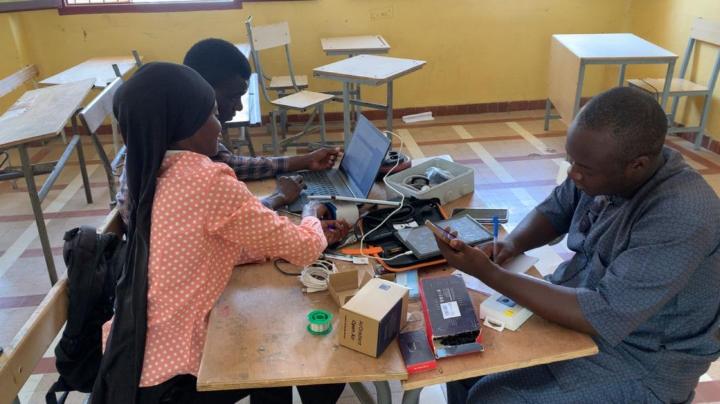
The final evaluation of the teams covered three categories: Innovation, Deployment, and Awareness. Each of these categories corresponds to an essential dimension of the project.
The Innovation category aimed to reward teams' ability to propose relevant technological or pedagogical solutions to improve the understanding, management, or communication around air quality.
The Deployment category focused on operational rigor: adherence to the deployment plan, quality of installations, sensor availability, responsiveness in maintenance, and documentation of interventions.
The Awareness category recognized teams' ability to mobilize communities, convey clear messages, and produce activities tailored to students, teachers, and other stakeholders.
The Hackathon's Winning Teams
8 teams participated in this competition.
At the end of the evaluation process, three teams stood out in the main categories.
Innovation Trophy : Les Jeunes Techs

The Les Jeunes Techs team wins the Innovation Trophy. They distinguished themselves through the relevance of their solution, the quality of the problem they targeted, and the technical potential of their work.
Deployment Trophy : Airus

The Airus team wins the Deployment Trophy. This award recognizes their strong field involvement, good capacity to monitor installations, and significant contribution to data continuity.
Awarness Trophy: Galsen IoT

An General Ranking Defined by Consistency

In the general ranking — established on the average of the three categories — Airus comes first with 87.4/100, followed by Galsen IoT (86.9/100) and Breath4Life (80.9/100). This ranking demonstrates that the best performances are not based on excellence in a single dimension, but on the ability to be present and effective on all fronts: innovate, act in the field, and raise awareness.
Breath4Life, third in the overall ranking, perfectly illustrates this logic. Bernard Tenguiano, a team member, sums it up aptly
The honor roll is as follows:
Key Figures That Reflect a Strong Impact
Beyond the competition, the hackathon produced concrete results in the field. The teams contributed to the establishment of a sensor network and the direct awareness-raising of school communities across the country.
The main key figures are as follows:
24 participants supervised by 8 mentors
More than 1,500 people reached, including students, teachers, and administrative staff
More than 40 sensors deployed across various sites
5 regions covered, from north to south
These results demonstrate that the teams did not only work on ideas or prototypes. They faced real field realities: site selection, sensor installation, connectivity monitoring, maintenance, school mobilization, and the facilitation of awareness sessions.
A Hackathon That Goes Beyond Competition
This hackathon was far more than a competition between teams. It created a dynamic of learning, accountability, and commitment. Participants developed technical skills, but also skills in communication, coordination, and community mobilization. Ultimately, one of the most important outcomes of the hackathon lies in the creation of an exceptional pool of young people capable of combining technical skills, understanding of air quality issues, and real-world experience.